How to find a water leak yourself
Complete DIY water leak detection guide
Think you may have a water leak?
Before you pay anyone to investigate it, there are several simple checks you can do yourself.
Some water leaks are easy to find. A leaking toilet, dripping tap, faulty irrigation valve or appliance connection can sometimes be identified in just a few minutes — without specialist equipment and without spending a cent.
Other leaks are much harder.
They may be underground, beneath concrete, underneath a driveway, inside a wall or below the floor slab. Those are the leaks that usually require specialist detection equipment.
Leak Trace created this guide for homeowners across the Sunshine Coast, Noosa, Moreton Bay and northern Brisbane who want to rule out the simple causes of water loss before paying for professional leak detection.
Our view is simple:
If you can find a water leak yourself, that's a good result.

First question: Do I actually have a water leak?

- To confirm a leak exists, follow these steps:
- Turn off all taps inside and outside the home.
- Ensure no appliances (dishwasher, washing machine) are running.
- Check your water meter and note the reading.
- Wait at least 30 minutes without using any water.
- Check the meter again. If the small dial or numbers have moved, water is escaping somewhere.
The DIY water leak checklist
1. Check Your Toilets

Toilets are the most common source of invisible leaks. Listen for a constant hiss or check the water surface for ripples. Drop food coloring in the tank; if color appears in the bowl without flushing, you have a leak.
Try the Food Colouring Test
Remove the lid from the toilet cistern. Add a few drops of food colouring to the water inside the cistern. You only need enough to clearly colour the water. Do not flush. Wait approximately 10–15 minutes. Then look inside the toilet bowl.
If coloured water appears in the bowl: The cistern is allowing water to leak into the bowl. Flush the toilet afterwards to clear the coloured water.
Don't have food colouring? Try this instead. Place a sheet of dry toilet paper against the back of the toilet bowl, just above the normal water level. If water is continuously trickling down the back of the bowl, the toilet paper will become wet.
2. Check every tap and shower
Check for slow drips from every tap in the house. Even a steady drip can waste thousands of liters per year. Don't forget to look under sinks for wet spots or water marks on the cabinetry. Check whether each tap completely stops flowing when turned off. Then look around the fixture itself.
Watch for:
-
moisture around the base
-
water stains
-
corrosion
-
slow drips
-
damp benchtops
-
swollen cabinetry
-
moisture underneath sinks
3. Look under sinks, vanities and cupboards
Many leaks stay hidden inside cupboards. Open the cabinet underneath:
-
your kitchen sink
-
bathroom vanities
-
laundry tub
Use a torch. Look around flexible hoses, fittings and connections. Run your hand carefully across the bottom of the cupboard.
Look for:
-
dampness
-
water marks
-
swollen chipboard
-
peeling laminate
-
rust
-
mould
-
a musty smell
Sometimes there is not enough water to create a puddle.
Instead, the first evidence is damage to the cabinet itself.

4. Check your washing machine, dishwasher & plumbed-in refrigerator

If it can be done safely, inspect the area behind and underneath your washing machine.
Check:
-
water hoses
-
hose connections
-
wall taps
-
the floor underneath the machine
-
the surrounding wall and cabinetry
Look for:
-
dampness
-
swelling
-
staining
-
mould
-
musty smells
-
moisture, corrosion or slow drips.
Flexible hoses can deteriorate over time and connections can occasionally loosen.
5. Hot Water System Pressure Valve
Do not forget the hot water system.
Walk around the unit and check for:
-
dripping valves
-
water around the base
-
wet ground
-
corrosion
-
moisture around pipe connections
-
water that appears to be continuously flowing
Some hot water systems discharge water as part of normal operation, so occasional discharge does not automatically mean something is wrong.
Continuous or unexplained water loss deserves investigation.
If you are unsure whether what you are seeing is normal, speak with an appropriately licensed plumber.


6. Check Outdoor Taps and Hoses
Verify all garden taps are turned off tightly. Check hose connections and irrigation systems for damp patches in the garden or unusually lush green spots in the lawn during dry weather. Make sure each tap completely shuts off. A slow outdoor leak can disappear directly into the ground. That means you may never see a puddle.
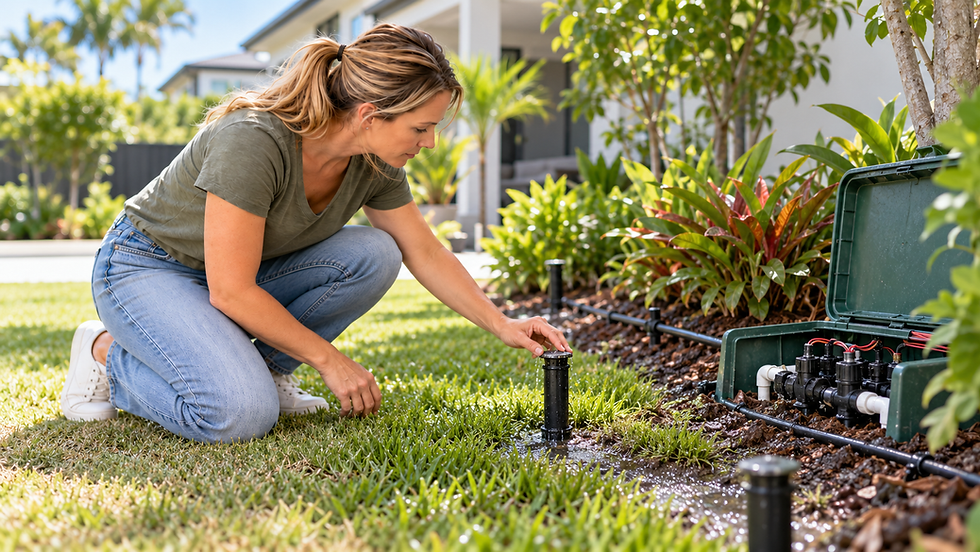
7. Check Irrigation and Sprinklers
Irrigation systems are another possible cause of unexplained water use.
Check:
-
sprinkler heads
-
irrigation lines
-
irrigation control boxes
-
solenoid valves
-
garden watering systems
Look for sprinkler heads that remain wet or continue leaking after the irrigation system is turned off. Also look for:
-
one section of lawn growing faster than everything else
-
unusually soft soil
-
a permanently wet garden bed
-
water appearing around an irrigation box
A faulty irrigation valve can allow water to pass through even when the system appears to be off.
8. Check water tanks connected to town water

Some rainwater tanks are connected to mains water so the tank can automatically top itself up. If a float, valve or solenoid fails, town water may continue entering the tank without you realising it.
If you have a mains-connected tank:
-
listen for water entering the tank
-
check whether it is filling when it should not be
-
check the overflow
-
look for wet ground around the tank
-
inspect visible valves and connections
9. Walk the entire yard
Now walk slowly around the whole property. Do not just look for obvious flowing water. Look for differences. Pay particular attention to:
-
unusually green grass
-
one patch of lawn growing much faster than surrounding areas
-
permanently damp soil
-
muddy patches during dry weather
-
soft or sunken ground
-
water beside concrete
-
moisture beside retaining walls
-
wet garden beds
-
dampness beside driveways
-
water moving toward drains for no obvious reason
An underground leak does not always produce a dramatic pool of water. Sometimes the clue is simply:
“Why is that one patch of grass so green?”

10. Look Inside for Signs of a Concealed Leak
A hidden leak may leave clues even when the actual pipe cannot be seen.
Look for:
-
bubbling paint
-
peeling paint
-
swollen skirting boards
-
mould
-
damp plaster
-
wall discolouration
-
swollen flooring
-
damp carpet
-
unexplained moisture
-
musty smells
Also pay attention to floors. If it is safe, walk across tiled or concrete areas. Does one section feel noticeably warmer than surrounding areas?
An unusual warm area can sometimes be associated with a leaking hot-water pipe beneath the floor or slab. But treat this as a clue — not proof. Do not start cutting concrete simply because one part of the floor feels warm.
11. Turn everything off and listen
Water escaping from a pressurised pipe can sometimes produce noise. Choose a quiet time to listen for a leak and turn off the:
-
television
-
music
-
fans
-
washing machine
-
dishwasher
-
unnecessary appliances
Make sure nobody is using water.
Then listen. You may hear:
-
hissing
-
rushing water
-
faint running water
-
dripping
-
water noise inside a wall
Try listening near:
-
bathrooms
-
kitchens
-
laundries
-
utility areas
-
places where you think the water supply may run
Important: The loudest point is not necessarily the exact location of the leak.
Sound can travel along pipes and through concrete and building materials. Do not start breaking walls or concrete based only on what you can hear.

12. Check around the water meter
Look around the water meter itself.
Ask:
-
Is the meter box full of water?
-
Is the surrounding soil unusually wet?
-
Is water appearing around the meter?
-
Is the meter still registering flow?
If your meter is moving while all legitimate water use on your property has been turned off, water is being drawn through the meter. If the problem appears to be on the public or utility side of the meter, contact your water service provider. For many properties across the Sunshine Coast, Noosa and Moreton Bay, the local water service provider is Unity water. If the leak is on your property side of the meter, investigation and repair will generally be your responsibility.
What If You Find the Leak Yourself?
Excellent. That is the best possible outcome from this guide.
If the cause is clearly:
-
a leaking toilet
-
an obvious dripping tap
-
an appliance connection
-
an irrigation problem
-
another visible plumbing fault
You may not need professional leak detection if you know exactly where to cut or dig.
Arrange the appropriate repair. Leak Trace does not repair plumbing. We specialise in finding concealed leaks. If regulated plumbing repair work is required, use an appropriately licensed plumber.


Water leak detection for Sunshine Coast and North Brisbane
We provide expert leak detection services across the Sunshine Coast and North Brisbane. Our precision technology finds leaks others miss. We offer comprehensive reports and fixed price quotes.
- Fixed $298 Introductory Rate
- Find It Or It's FREE Promise
- High-Tech Acoustic & Thermal Equipment
- Expert Plumbers & Leak Detectors
That is when professional leak detection starts to make sense.
Why we created this DIY guide
At Leak Trace, we believe in transparency. Not every leak requires professional equipment. We want homeowners to save money by identifying the simple issues first. If these steps don't work, that's when our specialist tools are needed.